Beyond Retail: The Rare Watches Collectors Are Chasing
Why the most desirable watches are often the ones you cannot simply walk into a boutique and buy.
There is a point in watch collecting where price becomes almost secondary.
The real question is no longer “How much does it cost?” but “Can you actually find one?”
At the highest end of the market, some of the world’s most coveted watches exist in a space beyond conventional luxury retail. They are produced in tiny quantities, allocated privately to established clients, discontinued after short production runs or created to commemorate moments that will never be repeated.
For collectors, this is where watches become particularly fascinating.
Because true rarity is not simply about being expensive.
It is about scarcity, provenance, desirability and access.
And, in many cases, the hardest part is not being able to afford the watch. It is finding the right example in the first place.
When a Watch Becomes Truly Rare
The words “limited edition” appear frequently in luxury watchmaking, but a limited production number alone does not make a watch collectible.
True scarcity usually emerges when several factors converge.
A watch may have been produced for an exceptionally short period. A particular dial may have appeared for only one year. A reference may have been discontinued while demand was still accelerating. Certain pieces may have been available exclusively through one boutique, market or retailer. Others were allocated directly to a small circle of established collectors.
Then there are watches whose rarity only becomes apparent years later.
The Audemars Piguet Royal Oak is a perfect example of how production history can shape collectability. Audemars Piguet’s own archives record that its Royal Oak Jubilee Ref. 14802, created for the model’s twentieth anniversary, was issued as a 1,000-piece limited edition, while production plans for the later Ref. 15202 initially called for only 300 watches in 2000. The Ref. 15202 was ultimately replaced by the 16202 in 2022.
What collectors eventually pursue is therefore not simply a model.
It may be one specific reference, from one particular production period, with one dial configuration, in exceptional condition and accompanied by the correct original documentation.
That distinction can transform the market for a watch.
Patek Philippe Nautilus 5711: When Discontinuation Creates a Grail
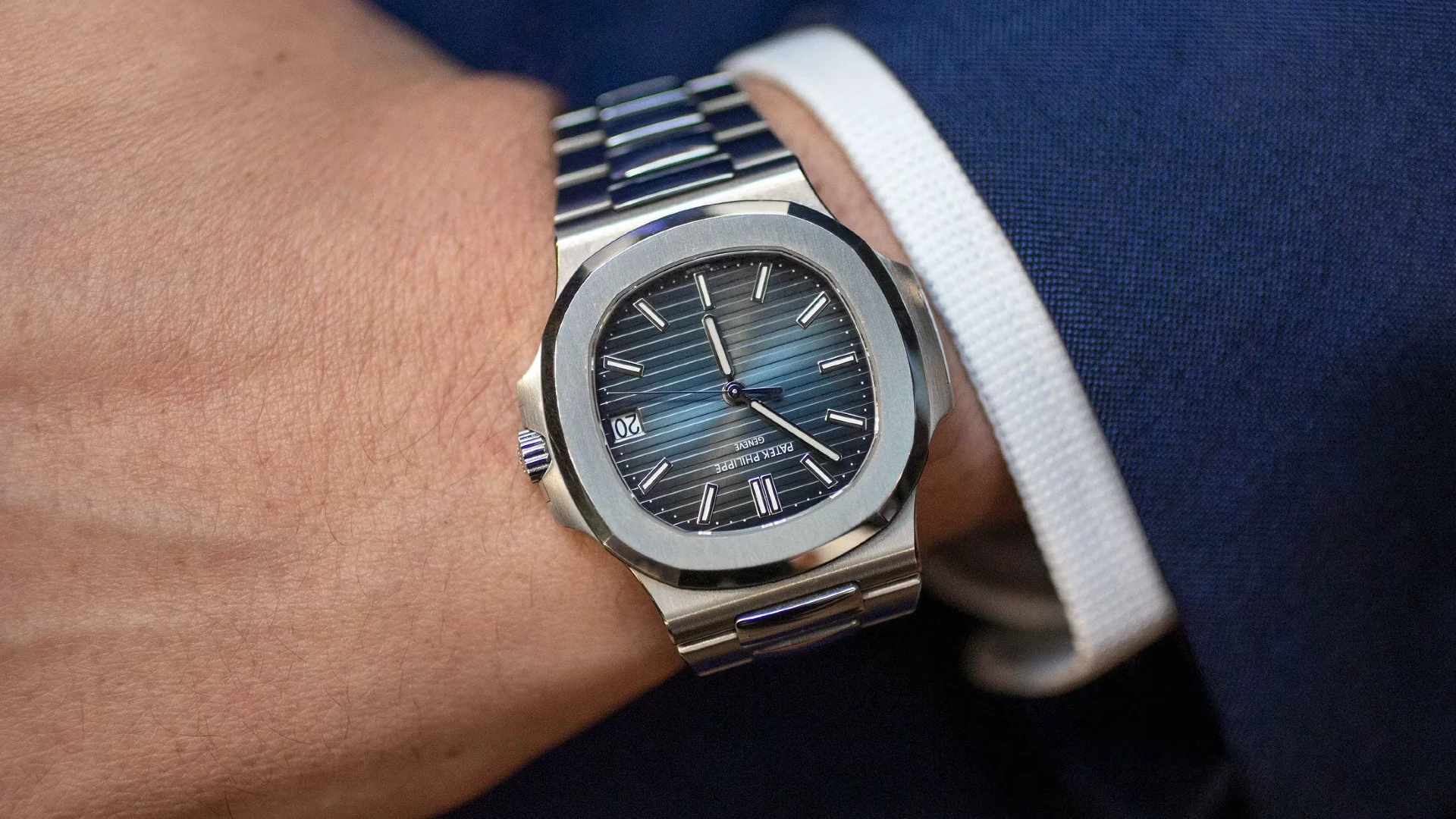
Few modern watches illustrate scarcity better than the Patek Philippe Nautilus Ref. 5711.
Introduced in 2006, the stainless-steel 5711 became one of the most recognizable luxury sports watches in the world. Demand eventually became so intense that acquiring one through traditional retail channels could involve extraordinary waiting periods.
Then Patek Philippe did something remarkable.
It discontinued the steel 5711 in 2021.
Instead of increasing production to satisfy demand, the manufacture ended the reference at the height of its desirability.
Its final chapter made the story even more compelling.
The olive-green 5711/1A-014 was produced for just one year and allocated in extremely limited numbers. It became the final regular stainless-steel expression of the reference before the Nautilus 5811 succeeded it in white gold.
And then came one of the defining collectible watches of the modern era.
The Tiffany Blue 5711.
Created to celebrate 170 years of partnership between Patek Philippe and Tiffany & Co., the double-signed Nautilus was limited to only 170 pieces. It combined several elements collectors prize simultaneously: an iconic discontinued reference, exceptionally limited production, a historically important retailer signature and an immediately recognizable dial.
Examples have subsequently achieved extraordinary auction results. Sotheby’s records a Tiffany Blue 5711 selling for approximately HKD 20.4 million in April 2023.
Its significance, however, goes beyond an auction result.
You cannot order another one.
You cannot ask Patek Philippe to produce one.
There will never be an additional 171st example.
Scarcity has been permanently built into the object.
Not All Scarcity Comes From Limited Editions
This is one of the most misunderstood aspects of collecting watches.
A watch does not need “1 of 100” engraved on its caseback to be extremely difficult to obtain.
Consider the Rolex Cosmograph Daytona.
The stainless-steel Daytona is a production watch, not a conventional limited edition. Yet the combination of extraordinary demand and controlled availability has historically made certain references significantly more difficult to source at retail than their catalogue status might suggest.
This creates what could be called commercial scarcity.
The watch theoretically exists in ongoing production, but the number of pieces available to the open market at any particular moment remains insufficient relative to demand.
The secondary market becomes the mechanism through which immediate access receives its own value.
As of July 2026, WatchCharts calculates value retention across the Daytona collection at approximately +39.4% relative to retail. But the same data also demonstrates why luxury watches should never be presented as guaranteed investments: its Daytona market index was up 7.3% over the preceding year while remaining down 7.6% over five years.
Rarity can support value. It does not eliminate market cycles.
That distinction matters enormously for serious collectors.
The Details That Separate Two Identical Watches
Suppose two collectors are offered exactly the same reference.
On paper, the watches appear identical.
In reality, their desirability may be very different.
Condition is fundamental. Over-polishing can alter the original geometry of a case. A replaced or restored dial can materially change collectability. Original bracelets, clasps, bezels and other components matter.
Then comes completeness.
Original box. Certificate. Warranty documentation. Manuals. Additional links. Service records. Accessories.
In the vocabulary of collectors, a particularly complete example is often referred to as a “full set.”
For important watches, these details can become critical. Sotheby’s collector guidance repeatedly emphasizes condition, originality and documentation when evaluating highly collectible Patek Philippe references.
And then there is provenance.
A documented history connecting a watch to an important collector, historical event or notable owner can turn an already scarce reference into something unique.
At this level, collectors are no longer comparing watches.
They are comparing individual objects.
Why Some Rare Watches Appreciate — and Others Do Not
Scarcity alone is not sufficient.
A watch produced in twenty examples that nobody wants remains difficult to find, but not necessarily valuable.
The pieces that have historically commanded exceptional collector interest tend to combine several forces:
Rarity. Few examples exist or regularly appear for sale.
Desirability. A meaningful number of collectors actively want the reference.
Historical importance. The watch represents an important moment for the manufacture, collection or wider history of watchmaking.
Condition and originality. The best-preserved examples become progressively more difficult to find.
Provenance and completeness. Documentation can strengthen confidence and distinguish one example from another.
Cultural significance. Certain references transcend watch collecting and become universally recognized icons.
When these characteristics intersect, supply is structurally constrained while global demand can continue to grow.
That is when the traditional relationship between age and value can reverse.
Instead of becoming obsolete, the right watch can become more desirable precisely because time makes it harder to find.
Finding the Watch Is Often Harder Than Choosing It
This is the part of luxury collecting that is rarely visible from the outside.
Finding a Royal Oak is one thing.
Finding the specific discontinued reference, in the correct configuration, with the desired dial, in excellent condition, with the right provenance and documentation is something entirely different.
The same applies to a rare Nautilus, an exceptional Daytona or a highly limited Richard Mille. Richard Mille itself describes its watches as being painstakingly produced in limited quantities, with technical complexity naturally restricting output.
Pieces of this calibre may never appear in a conventional online catalogue.
They move through collectors, private dealers, specialist inventories, auctions and trusted sourcing networks.
Access becomes part of the luxury itself.
Dolce Vita Shopping: Sourcing What Is Difficult to Find
This is precisely where Dolce Vita Shopping distinguishes itself.
Our approach to watches goes beyond presenting what is readily available.
We focus on the search for the exceptional: rare references, discontinued models, limited editions, unusual configurations and highly desirable pieces that can be extremely difficult to locate through traditional retail channels.
For our clients, sourcing is not simply about finding a watch.
It is about finding the right watch.
The correct reference. The preferred configuration. The condition expected by a discerning buyer. The documentation that should accompany it. And, above all, a piece worthy of the collection it is entering.
Because at the highest level of luxury, the most valuable service is sometimes not selling what everyone can see.
It is knowing where to look for what almost nobody can find.
Dolce Vita Shopping — We find what others cannot
Tell us what you're hunting →